
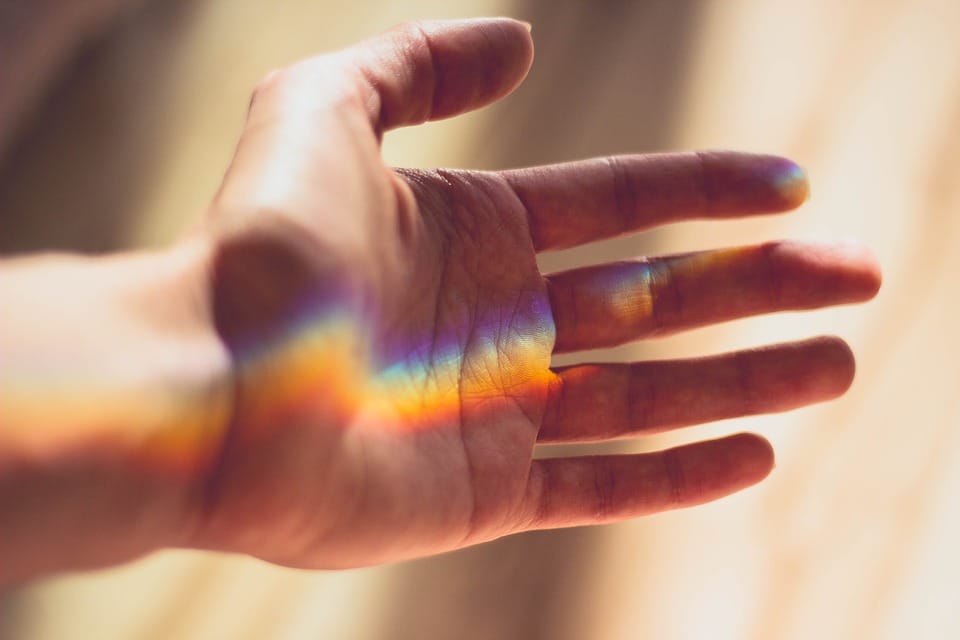
Whenever anyone looks towards a beam of light, they wonder what are the colors of light? Is it simply white or a mixture of some specific colors.
I got the answer and I am here to answer all your questions regarding the colors of light.
Table of Contents
What are the colors of light?
Whenever the word light comes into the picture, most of you start thinking about sunlight, or flashlight in your phones or bulbs.
Most of you think that the light is simply a beam of white color and nothing else is there. But let me tell you that this isn’t the case. The science behind the colors of light is something else.
Light
So, to know about the colors of light, it is obvious that we should know what exactly light is?
To be exact, light is a form of energy. It is basically electromagnetic radiation.
White light
Visible light or white light is actually an electromagnetic spectrum of lights of different wavelengths that fall in the visible region.
The colors present in white light are 7 which are together known as VIBGYOR. These are violet, indigo, blue, green, yellow, orange, and red.
If I focus all the 7 colors mentioned above, the mixture of colors will appear to me as white!!
Sources of white light
This white light can be natural as well as man-made. The sources like the flashlight in our phones, handy torches, LED, etc produce artificial white light.
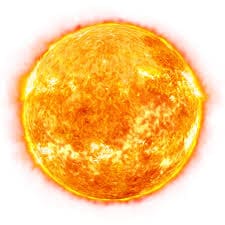
Heavenly bodies like the sun, stars, etc produce natural white light.
Why does white light appear white?
Now you all will start thinking that if white light is a mixture of different light, then how is it white?
According to this mixture, it makes, it should be something else but not white. So, to make you drop all your thoughts let me tell you there is no such thing as ‘white light’!!
Yes, white light has never existed. In other words, the color white is just a trick that our eyes play with us.
The white light basically appears white because when we see it, the colors of light reflect all the child colors.
Let me give you an example to understand it better. Most of you know that why an object appears the color it has right?
For those who don’t know it let me tell you. If we consider a leaf it has a green color right?
It actually appears green to us because the leaf reflects all the 6 colors from VIBGYOR expect green. This eventually makes the leaf green for our eyes.
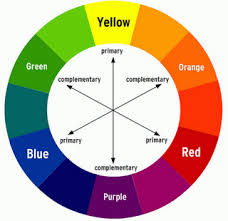
This same thing happens with light. Actually, the colors of light are a mixture of 7 colors and the mixture is able to reflect all the 7 colors. This eventually results in appearing the light white in color.
When you put a white paper under red light it appears red right? but when you put green paper under red light it appears green!!
This happens because the green paper is able to reflect green light but because the other paper is white it will just reflect the singular wavelength light.
So why does an object appears black?
So, you all will start thinking that if an object reflects all the colors it appears white, then how can an object appear black?
An object appears black because the object is unable to reflect light into our eyes. It simply absorbs it.
Is black is real??

Similar to white, black is also a result of a trick that science plays with us!!
Black does not exist in reality. When an object does not reflect any color out of the 7 colors it appears black to our eyes.
This happens because light cannot enter our eyes. This is the reason we are barely able to see in the dark, as we see objects if they reflect light.
Theory of combination of colors of light
This theory regarding the combination of colors of light was first given by Issac Newton.
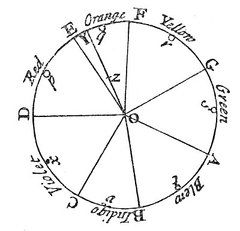
He developed a circular wheel and divided it into 7 parts. This explained the nature of the resultant of adding or subtraction colors.
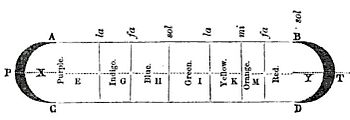
At first Newton used only 5 colors, but after some time he added 2 more to his wheel. The colors that were added afterward, were Orange and Indigo.
Different mnemonic devices for colors of light
Apart from the VIBGYOR mnemonic, there were several other mnemonic devices regarding the collection of colors of light.
The Munsell color system which was the first color notation system published in 1905 consists of only five colors yellow, red, green, blue, and purple. It was also known as principal hues.
“Richard of York Gave battle in vain” is the most common device which came from Britain.
What is the proof regarding the colors of light?
Many of you are thinking that what is the prove that white light is really a combination of seven colors!!?? So yes there is proof regarding this, more specifically there is scientific proof regarding this.
Scientific phenomena that prove that white light is a combination of seven colors is known as the dispersion of light.
Dispersion of light
The proof of this phenomena was established when white light was passed through a Prism glass. Surprisingly when the light came out from the prism it was clearly seen that it is a band of seven colors.
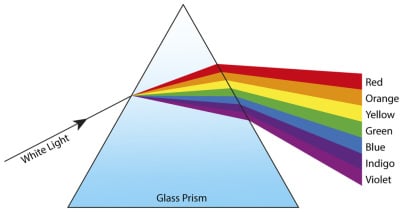
This phenomenon takes place because light has a tendency to bent when it passes from one medium to another. This tendency of bending of light is known as refraction.
In the case of a Prism light passes through the rarer medium to denser medium making it bent. We know that different colors of light have different wavelengths and the bending angle will vary.
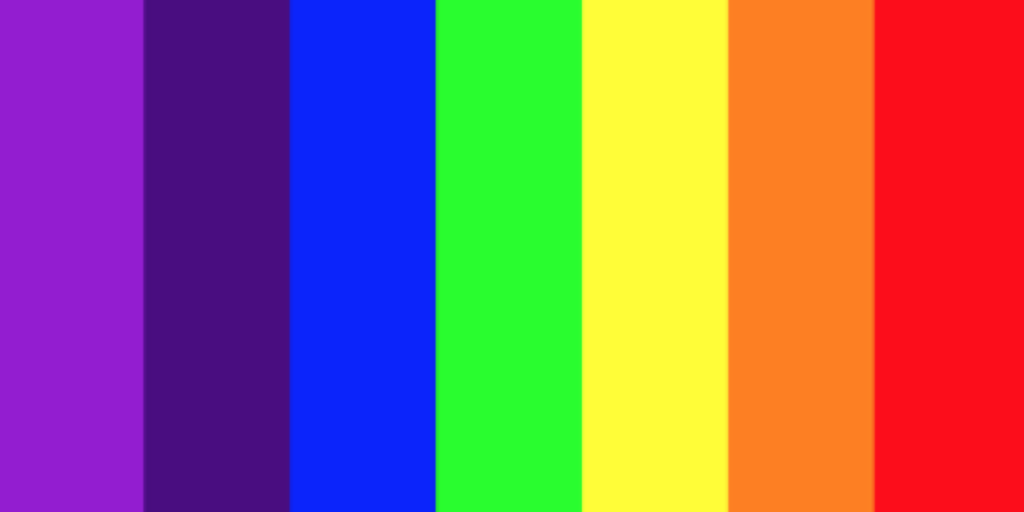
The light is entering in a denser medium the speed will become slower and every different color of light the speed will change hence in the resultant wave the difference can be clearly seen.
To know the details of the dispersion of light click here.
Natural phenomena based on the dispersion of light
Rainbows
If you ask that which is the most beautiful phenomenon caused due to the dispersion of light, the answer will surely be rainbows!!

Who doesn’t like rainbows they are beautiful, attractive and something which makes us adore nature right? The band of 7 colors which appears after rain, fills everyone’s heart with happiness.
Ever wondered how the rainbows are formed? Yes, you are thinking right, dispersion is the phenomena that cause the formation of rainbows.
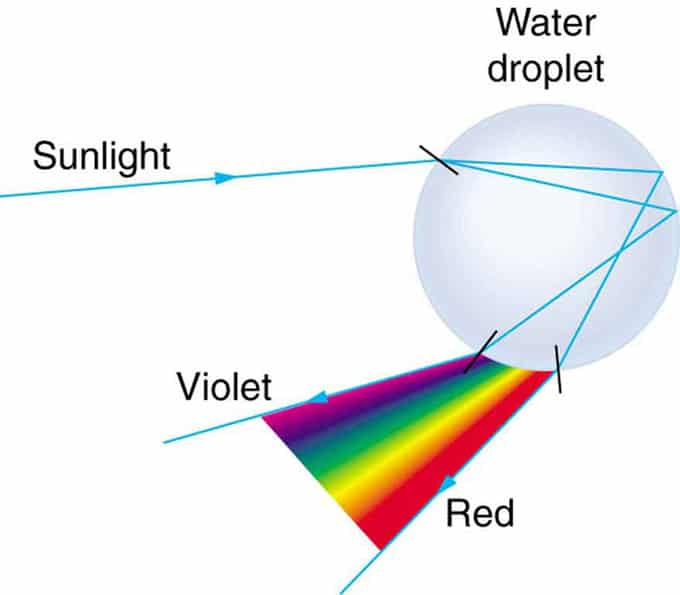
After the rain, some water droplet contents due to sudden changes in temperature and they hang in our atmosphere. The water droplets act as a prism to the sunlight. When sunlight falls into these droplets it gets reflected, refracted, and finally diffract lastly to the phenomenon dispersion causing the formation of a beautiful rainbow.
Apart from rainbows when oil droplets are on flour and water gets mixed with them the same phenomena can happen. There is a probability that light will fall into it and dispersion will take place.
Numerical values regarding colors of light
| Color | Wavelength (nanometer) | Frequency(Thz) |
| Violet | 700-635 | 430-480 |
| Indigo | 635-590 | 480-510 |
| Blue | 590-560 | 510-540 |
| Green | 560-520 | 540-580 |
| Red | 520-490 | 580-610 |
| Orange | 490-450 | 610-670 |
| Yellow | 450-400 | 670-750 |
| Color | Energy (eV) |
| Violet | 2.95 |
| Indigo | — |
| Blue | 2.64 |
| Green | 2.34 |
| Red | 1.77 |
| Orange | 2.00 |
| Yellow | 2.14 |
Conclusion
After knowing the real reason for seeing a white light, we can say that what we see is not always the truth. Somethings are not visible to our eyes, but yet they are present in nature. Science is everywhere around us.
Frequently Asked Questions
People Also Ask
1) How many colors of light are there ?
Generally, there are seven colors of light that make it a White Light namely, Red, Orange, Yellow, Green, Blue, Indigo, and Violet. Its often represent as VIBGYOR representing the initial letters of each color.
2) What two colors make White ?
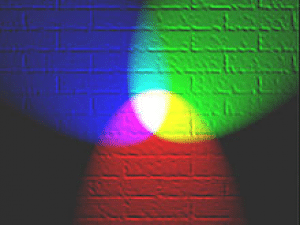
If we mix Red, Green, and Blue in the right proportions, we can get White color. Also, in terms of wavelength, mixing two colors with appropriate wavelengths can give us white. For example, yellow with 580 nm and Blue with 420 nm wavelength mix together to give a white color
3) Which color of light has the most Energy?
Violet has the most energy. It is generally because of having the shortest wavelength among the seven colors. So the lowest frequency would lead to the high frequency which would further lead to more waves and thus more energy that will be getting transferred from one point to another.
Recent Posts
You can view the latest posts from the below links :
[…] The Vibrant colors of light: True colors of light […]
[…] bending of light. That bending of light is due to the diffraction of light. To know more about the colors of light click […]
[…] The Vibrant colors of light: True colors of light […]