
Have you seen those large dams build over rivers? Do you know why they are made? We can say that the massive concrete structures present over waterways are basically for the purpose of hydroelectricity.
Let’s start with some interesting facts of hydroelectricity.
Table of Contents
What is Hydroelectricity?
Most of you have heard about the word hydroelectricity, but do you know what does it mean?
In simple words, we can say that any hydraulic source especially water (a liquid state of matter) that generates electricity can be termed as hydroelectricity.
It’s a form of renewable energy that is generated by power stations and dams.
Dams are built to block the water flow, which makes waterfalls from a required height when required to generate the electricity.

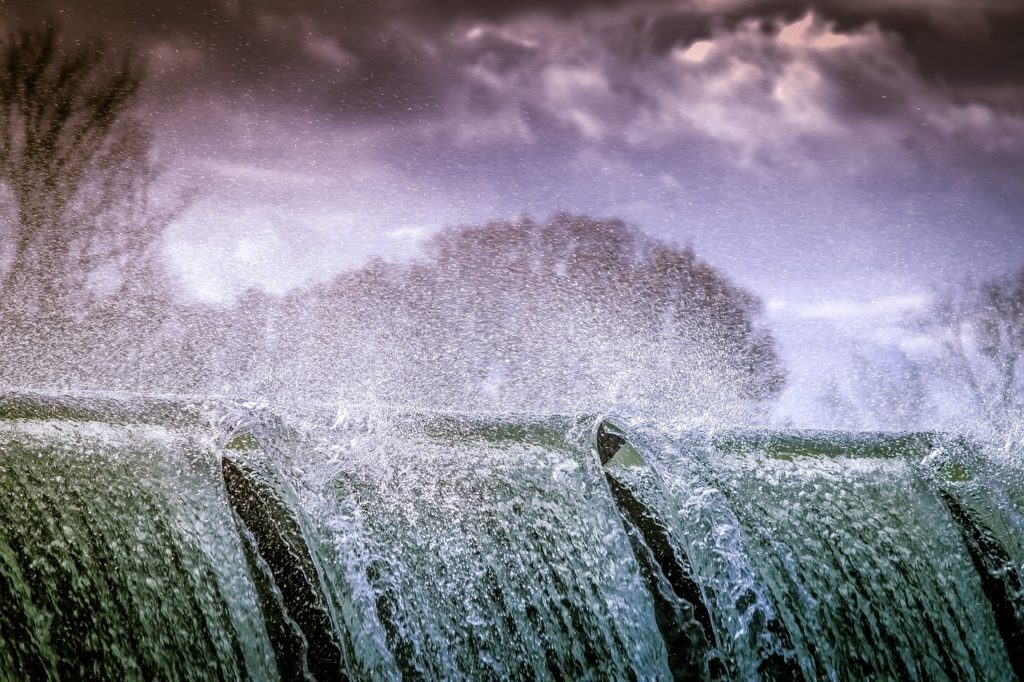
The above picture gives you a rough idea of how a water dam looks like. As said earlier they are large build concert structures that stop the flow of water bodies which further is being used to generate electricity, thus called hydroelectric power plant.
Hydroelectricity Dictionary definition
As you can see hydroelectric plants are built over rivers for extraction of hydraulic power.

Hydroelectricity is derived from “hydro” + “water”. So, it means that any hydraulic source generating electricity is generally called as hydroelectricity or hydropower.
It incorporates the conversion of energy from flowing of any hydraulic fluid especially water into electricity.
It is considered as a renewable source of energy because the water cycle is constantly renewed by the atmosphere.
Generation of Hydroelectricity (Concept Phase)

The movement of water resources along with a proper plant setup leads to the generation of hydroelectricity.
Generally, the falling water from the dam generates enough amount of force which rotates the turbine connected with an electric generator.

So now, the potential energy of stored water at height is converted into the kinetic energy of flowing water, which in turn is converted into the mechanical energy of rotation of the blades of the turbine.
The turbine is connected with an electric generator where the mechanical energy is converted into electrical energy.
For example, think of waterfalls like Niagara Falls. As shown above, the same scenario occurs here for the generation of electricity via the conversion of different energy into electric energy.
Step by step explanation of generating hydroelectricity
Firstly let’s understand the concept of potential energy and kinetic energy.
As in the below picture, you can notice that the air in the filled balloon is static and has potential energy stored in it.
But when the endpoint of the balloon is opened, the air comes out and the balloon gets diminished.
This is because the potential energy of the air being stored in the balloon is converted into the kinetic energy of the fast-moving air.
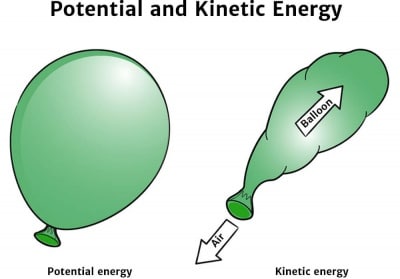
Similarly, the dam is the endpoint of the balloon which acts as the closing point of the water to flow thus storing the water as potential energy.
Now the water flows when the dam gates are opened. In this process, the stored water as potential energy is converted into the kinetic energy of the flowing water.
This flowing water has a significant momentum that it rotates the static blades of the turbine. In this process, kinetic energy is converted into mechanical energy as shown in the below figure.
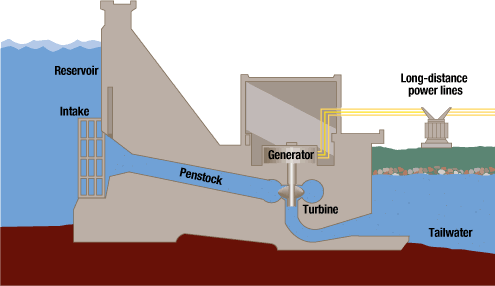
As in the above diagram, the turbine is mechanically coupled with the generator which thus helps in the formation of electricity by converting the mechanical energy into electric energy.
So, once the electricity is produced, it is then fed to the long-distance power lines for electricity supply.
Different components associated with hydroelectric power plant
Till now, we have learned about what is hydroelectricity and how does it work along with the mechanisms involved in it.
So now, let’s look into the major components associated with the hydroelectricity power plant:
- Reservoir
- Intake gate
- Penstock
- Turbine
- Generator
- Powerhouse
- Draft tube
- Tailwater
Generator and Turbine
The below diagram represents the generator coupled with the turbine for the process of hydroelectricity.
The generator in the turbine plays the most crucial role in the production of hydroelectricity.
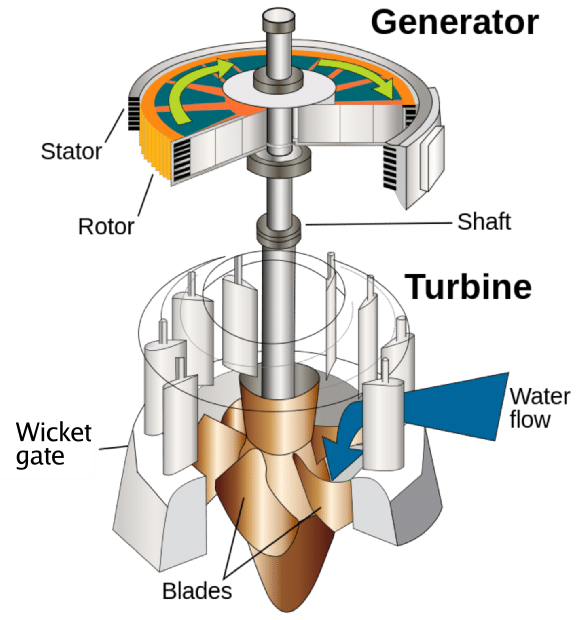
The Turbine and the Generator are the core or we can say the central part of the hydraulic plant. Let’s see how they work. Firstly, the water enters through the Wicket gate and the gate gets closed. The wicket gates are controlled by an external governor system.
When the load on the system is narrow, the gates get closed and when the pressure is more, the gates get open.
Further, the blades extract the maximum possible spin energy from the water. After this, the turbine makes the water flow in a turning pattern.
The shaft connects the turbine and the generator with the electrical DC supply.
The stator is the outermost part of the generator. It is made up of three copper bindings.
Inside the stator, is the rotor. The rotor is covered with several magnetic bars. The magnetic bars are charged by using an external electric source. Eventually, these magnetic bars are arranged alternatively north and south poles.
These magnets produce a circular electric field. As the rotor starts rotating inside the stator, the magnetic fields produced starts interacting with the stator windings. When a single magnet completed one full revolution, 1 pulse of AC power is generated inside the bindings.
This action takes place in every other magnet. Hence, producing a sinusoidal alternative current supply.
Reservoir
The use of a reservoir is to store water from lakes, rivers, and rainwater. Before using the water, it is cleaned using different chemicals.
Different chemicals are added to the water which helps to remove unwanted particles like minerals and bacteria.
Intake Gates
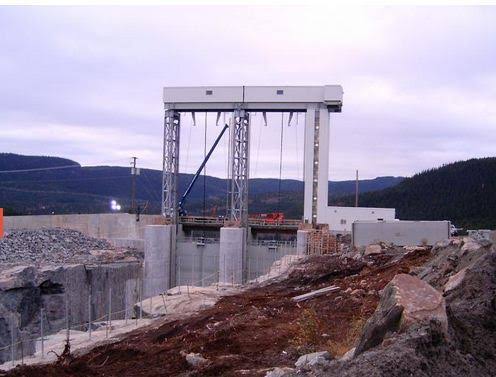
The above picture is of intake gates. They are Pathways for the water to flow inside the dam. This controls the flow of water from the dam. The intake is essential during the operation of the system.
When the gates are open the water flows from the reservoir and enters the penstock after which all the process takes place.
Penstock
These are large pipe structures that carry water from the intake gates to the turbine.
The penstock walls are mainly composed of reinforced cement or steel.
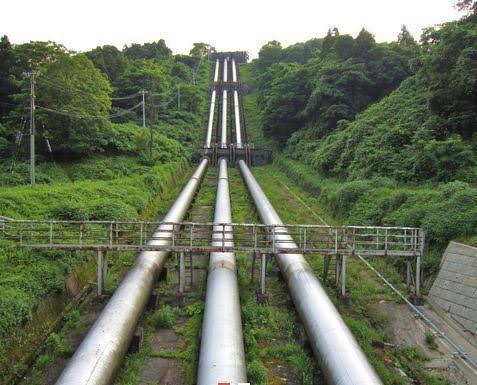
By seeing the above picture you can get an idea of how big the penstock is. If the distance between the intake Gates and the turbine is small then many penstocks pipes are used. On the other hand, for long-distance, a single penstock is used.
Powerhouse
Don’t confuse it with any housing shelter. Yes, we can say that it is kind of similar to a typical house, but just in the structure. It usually has 2 floors, which is the ground and first. These are big building setups that are mainly used for giving shelter to the turbine, generator, and other hydraulic and electrical parts.
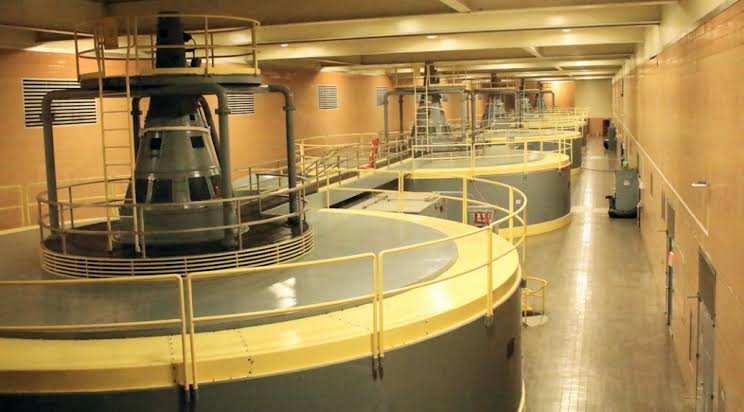
Inside the building on the ground floor, the turbine and generator are present. In the first word, we can see the control room.
Draft Tube
It is the connection pathway which joins the turbine and tailwater or tailrace. The structure of the draft tube pipe is kind of different from the penstock.
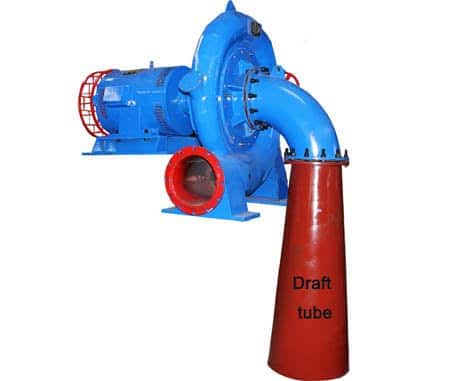
The diameter of the pipe becomes larger with distance. This is for decreasing the speed of the water so that the water gets inside tailwater with the proper velocity.
Tailwater
We can say that tailwater is the last part of the whole significant and bulky system. It is the immediate amount of water located after the turbine system.
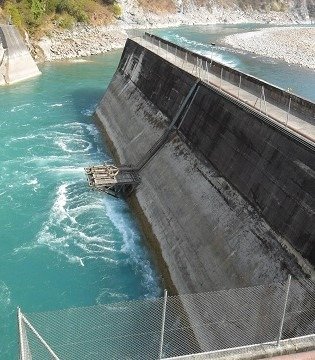
The average depth of the water is based on downstream of the hydraulic system.
Is hydroelectricity renewable or non-renewable?
Yes, Hydroelectricity is renewable. This is because the water used for producing electricity can be used again and again.
This means a small amount of water can generate electricity for a very long time. It makes the hydroelectricity even sustainable. Isn’t it fascinating, we can produce power and the source is not going to abolish!!
Advantages of hydroelectricity
There are many advantages of hydroelectricity, which makes it very useful for electricity production and most widely being used in many parts of the world.
Some of the advantages are depicted below:
- Renewable source of energy.
- Guaranteed production of power through water.
- All the resources required for the production are already available by nature. Consequently Low-cost production.
- The plants build for the generation of hydroelectricity are useful in rainwater harvesting too!
- The availability of hydroelectricity is reliable. We can say this because the capacity of hydroelectricity to reach from zero to its peak is very fast.
- It produces a very less amount of greenhouse gases. So, this prevents environmental damage.
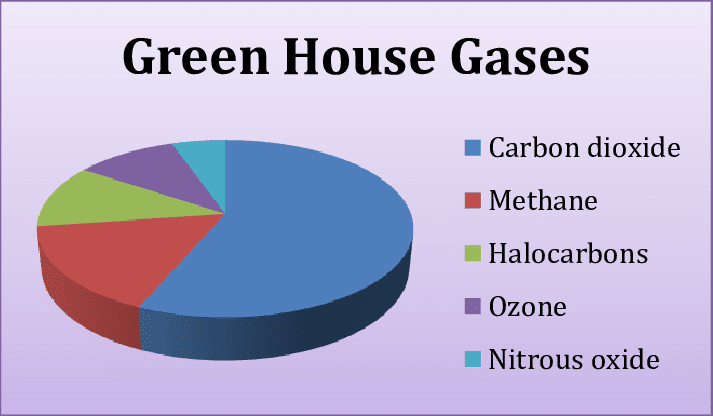
- Above all, this production process does not release any pollutant gas in the air.
- The production process is easy and efficient, so it makes hydroelectricity build a strong pillar in development.
- This a future form of energy.
- Helpful in sustainable development.
Disadvantages of Hydroelectricity
As we all know, everything has good and bad sides. In the case of hydroelectricity, this fact is also applicable. We know that hydroelectric production has many advantages, but it has some disadvantages too!!
- The power plants build over rivers changes the direction of the water.
- So, this affects marine life by blocking their paths.
- It requires a lot of maintenance and care. Therefore it is kind of costly.
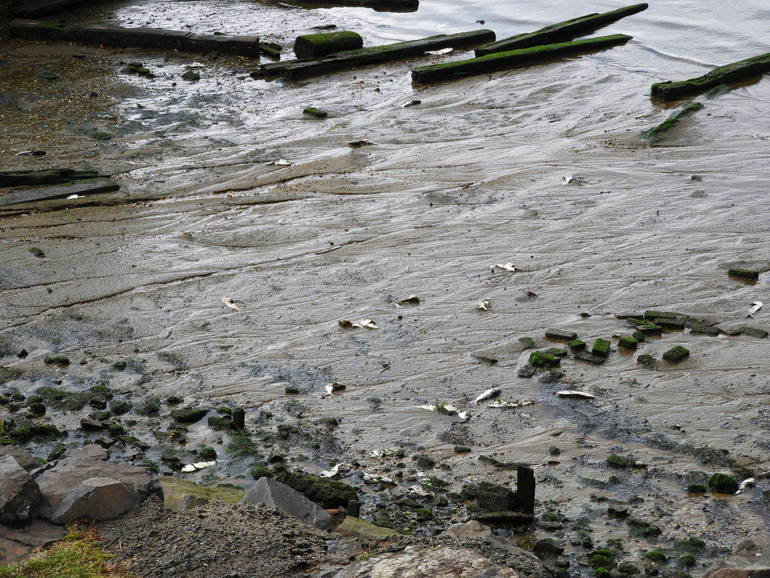
- Imagine water vanishes from Earth. As a result, hydroelectricity cannot be generated.
- Limited area for building dams.
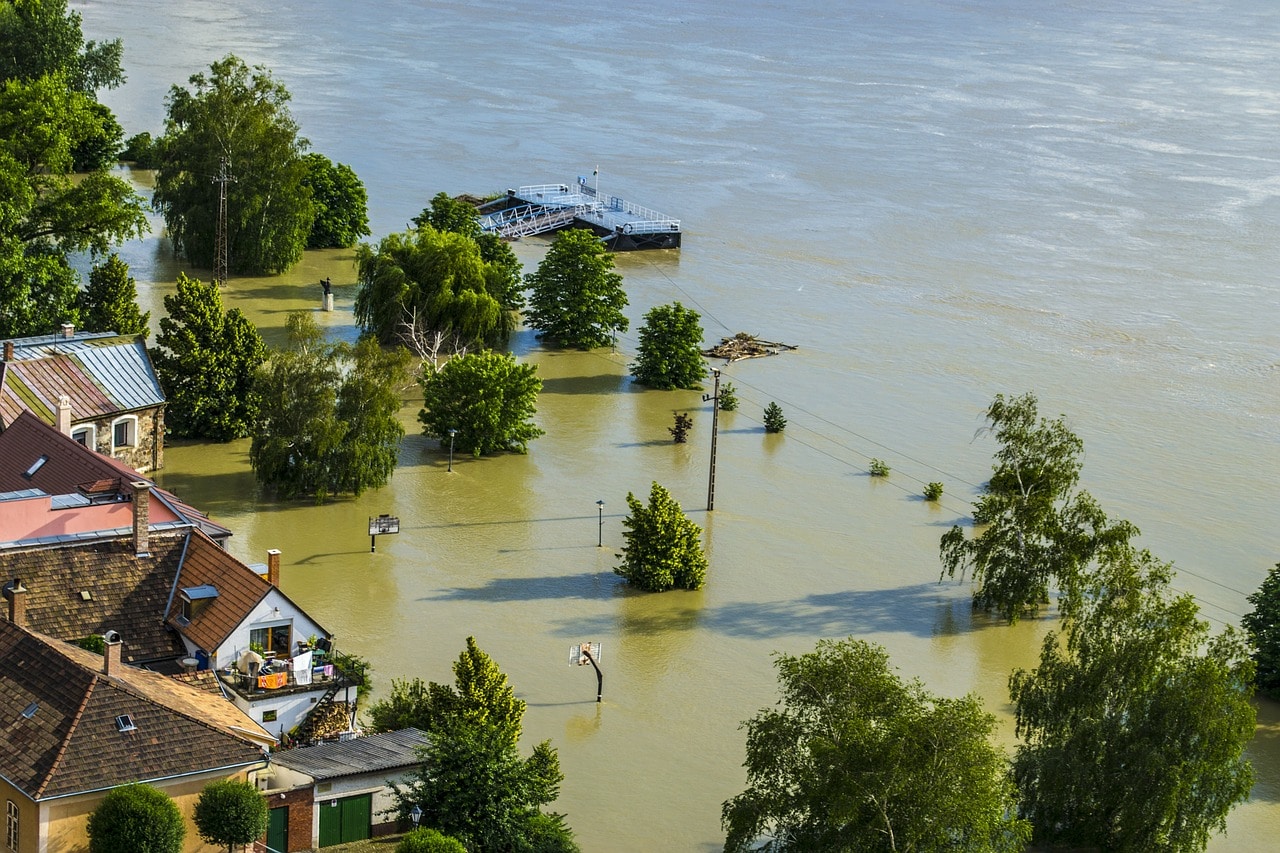
- The risk of flood is common as well. This is because of the higher heights of dams.
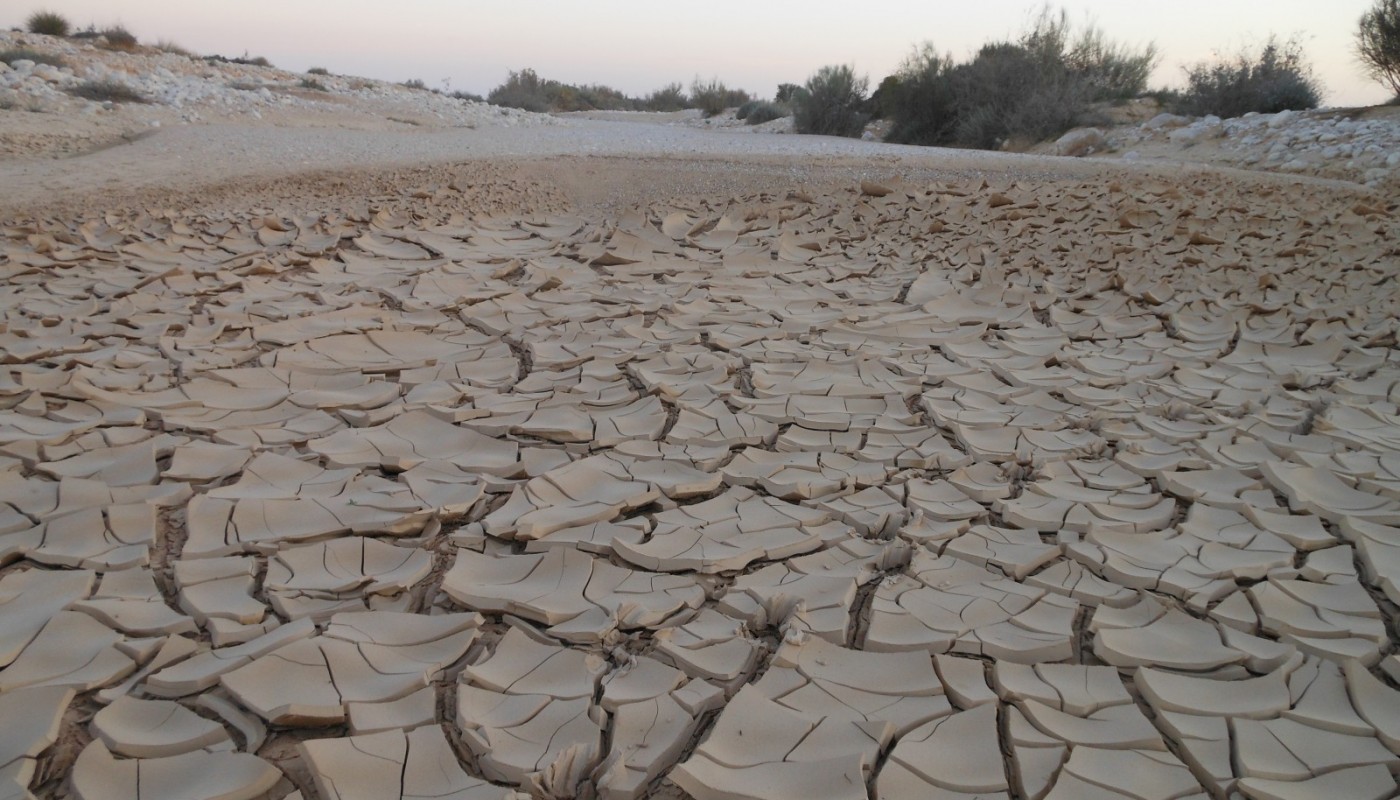
- Climatical changes affect the environment, leading to droughts
Facts about Hydroelectricity
Let’s get to know some mind-blowing facts about hydroelectricity:
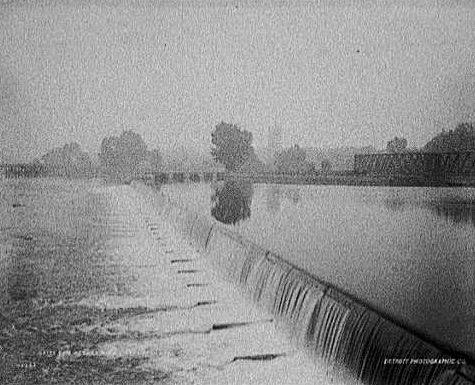
- On 30th September 1882, the first hydroelectric plant was built.
- The river was the Fox river located in Appleton, Wisconsin (United States).

- The first hydroelectric plant in India was built in 1887. In a small town of Karnataka, Belagavi over the Gokak falls.
- The generation of hydroelectricity depends on gravitational force.
- The higher the distance between the turbine and the water source. As a result, more energy can be produced.
- The pumped-storage hydroelectric power plants pump the water back up to the storage.
- Most of the plants are located at higher altitudes. Because the generation depends on the production of potential energy.
- Almost 71% of the earth’s electricity is hydro-power.
List of largest 10 hydroelectric plants in the world
| Dam | River | Place | Production capacity (GW) |
| Three Gorges Dam | Yangtze River | China | 22.5 |
| Itaipu Dam | Parana` River | Brazil | 14 |
| Xiluodu Dam | Jinsha River | China | 13.860 |
| Guri Dam | Caroni River | Venezuela | 10.235 |
| Tucurui Dam | Tocantins River | Brazil | 8.370 |
| Grand Coulee Dam | Columbia River | United States | 6.809 |
| Xiangjiaba Dam | Jinsha River | China | 6.400 |
| Longtan Dam | Hongshui River | China | 6.426 |
| Krasnoyarsk Dam | Yensei River | Russia | 6.000 |
| Robert-Bourassa Dam | La Grande River | Canada | 5.616 |
Moreover, the largest dams are mostly present in China, Brazil, and Canada.

The above picture is of the Yangtze River which is located in China. It is known for the biggest Dam which is located on it.

The above picture is of the three gorges Dam, built on the Yangtze river in China. The largest hydroelectric plant in the world is in China. It is the largest dam in the world. It is 7660 feet long and 607 feet tall. This produces 22,500 megawatts of electricity.
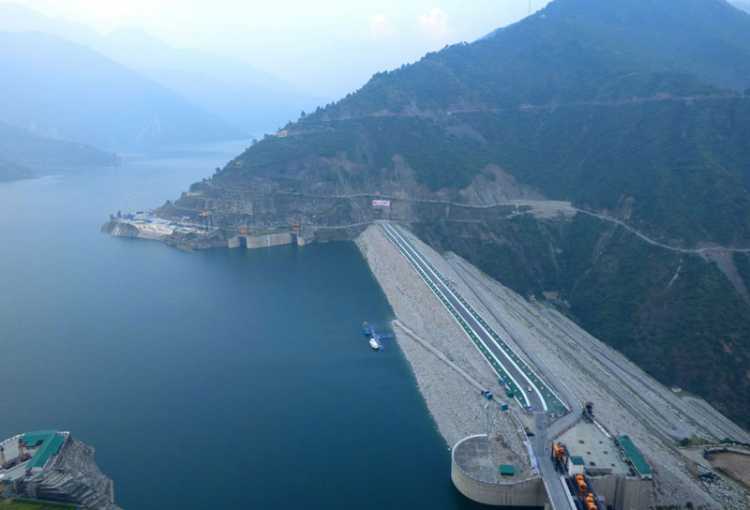
Also, the largest dam in terms of size in India is Tehri Dam which is shown above. It is located on the Bhagirathi river in Uttarakhand. By seeing the pictures above, you can imagine why it is the largest dam in India.
What are the economic benefits of Hydroelectricity?
Hydroelectricity does have a reasonable amount of economical benefits. Moreover, it provides moderate electric bills for ordinary people.

Further, it provides job opportunities in the area of plant setup. Apart from this, it gives publicity to the city, hence increasing tourism. The above picture shows that nowadays there is development in work opportunities with the building of hydro plants.
What is the cost of building a Hydroelectric plant?
The electricity produced is quite cheap. The building cost of plants is kind of expensive. As the cost of building a hydro-power plant can range from 7 to 9 crore.
Uses of hydroelectric plants
Apart from generating electricity, hydroelectric plants are useful in many other ways.
It is an excellent site for setting up businesses. It is so as, the availability of power supply will be plenty and cheap. This helps the industries which involve machinery work to grow faster.
Types of Hydro-power plants
As per the definition, we know that hydroelectric plants use dams for obtaining potential energy from water.
But what about some places like the Niagara Falls? Their water already falls from a sufficient height to produce tremendous Mount of kinetic energy? This kind of situation doesn’t need dams for increasing the water flow.
There are some other types of plants for producing hydropower.
Impoundment type
It is the most common type of plant. This uses Dams for the process.
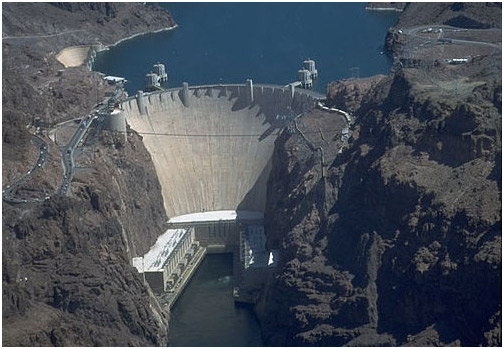
The above picture shows the structure of the impoundment arrangement. This system stores the hydro-power for further conversion.
In this system, electricity is generated by moving water from the reservoir through the turbine. This turns the generator and hence produces electricity.
The construction of this system is very large in terms of size.
Pumped storage type
It mainly functions like a battery. Just like a battery it first gets itself charge and then provides electrical flow.
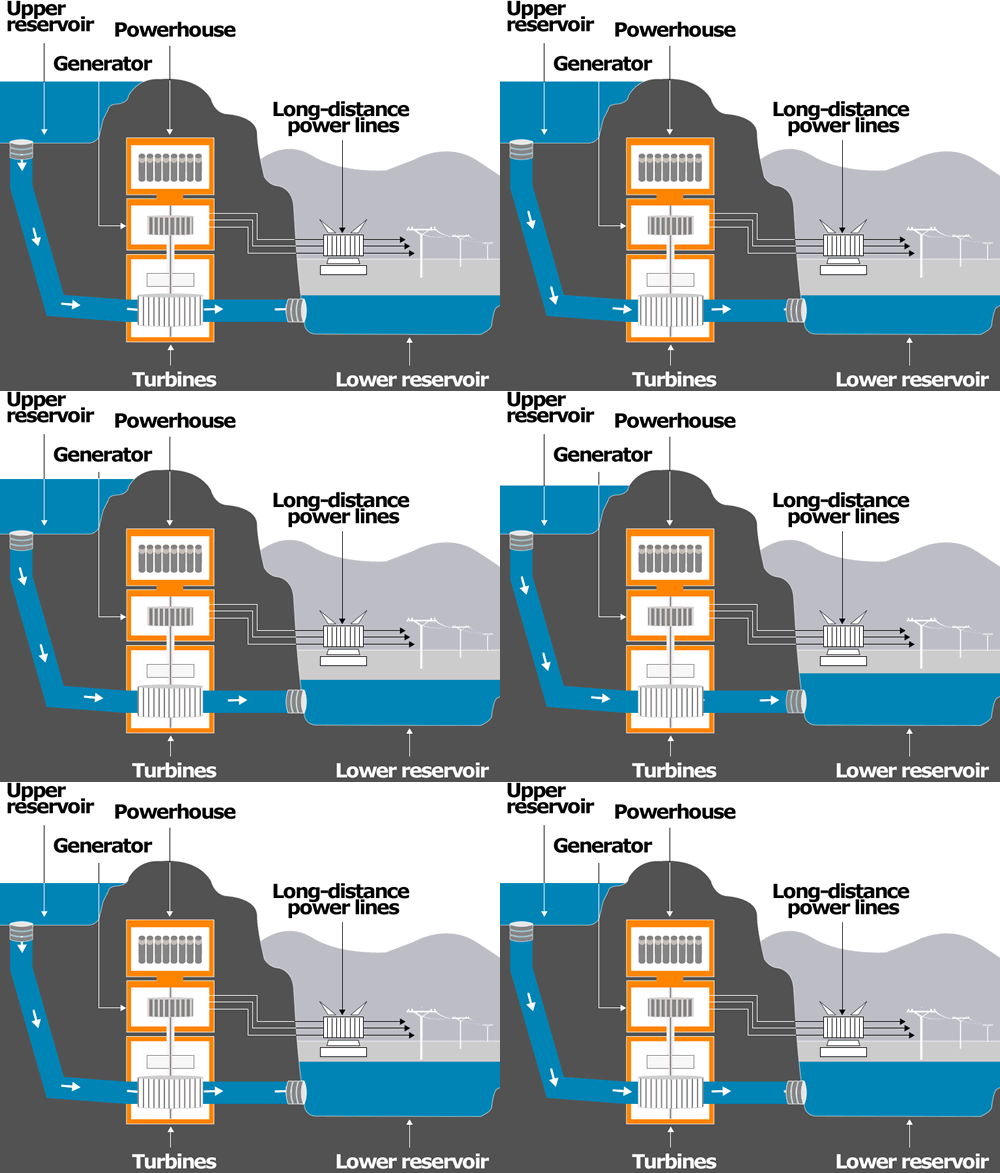
The GIF above shows the movement of the direction of the flow of water in the Penstock. With the help of Penstock, the pumping of water uphill to the reservoir at a greater height from a lower height takes place. This is for storing energy.
This stored energy is further converted into electricity as per the demand.
Diversion type
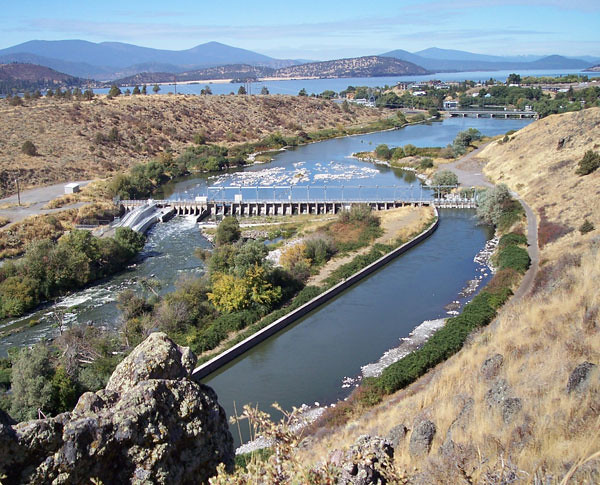
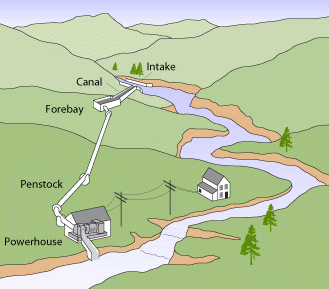
In a diversion type setup, the turbine is set into a channel of water. When the water flows through the channel it moves the turbine, generating kinetic energy. This facility stores a negligible amount of energy. It is shown in the picture that through a canal, a dam is built for retrieving hydropower.
Offshore type
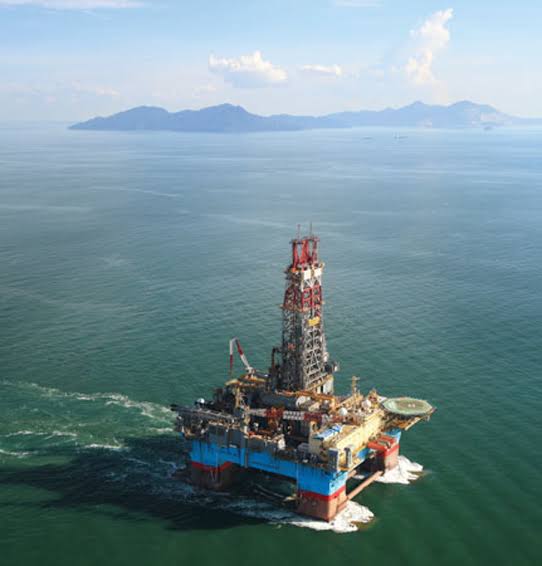
This is a very rare setup. The tidal energy of seawater is processed regarding the generation of electricity. In the above picture, we can see that it is set up in the middle of water bodies which is very costly and expensive to maintain.
Hydroelectricity model
This power generation model is quite popular among students. These kinds of models, most of the time we can see in schools and colleges.
Because students intend to make hydroelectric models by adding their features.

This adds a high chance of further development of water generated electricity.
Hence, this provides a lot of future opportunities.
For the ease of building the models, Hydroelectric kits are also available in the market.
Future scope
Nowadays, around the world hydro-power is a key element in the production of electricity.
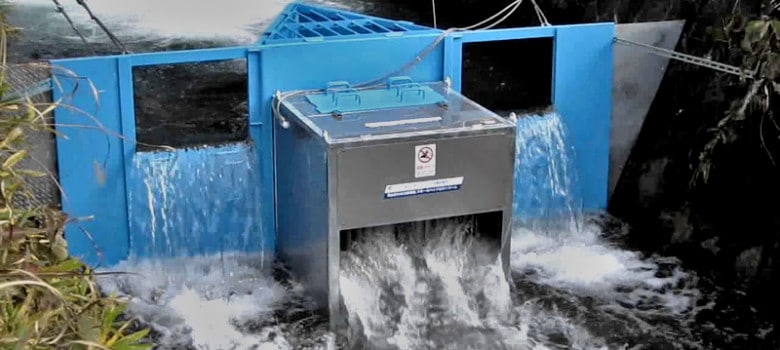
Small scale hydroelectricity, to large scale, both uses hydro-power. The production does not produce any toxic gas. We can see in the picture that a small scale hydroelectric plant setup for matching the needs of a small business.
But, the problem regarding this is the harm to marine life.
This system can harm the life of species like fishes, by blocking their normal path.
The production of electricity through water is very convenient. It is because of the abundance of water on earth.
This system is a renewable source. This means that the same water can be used over and over without making water extinct.
Conclusion
Water on earth is present in an abounded amount. Even if it is not fit for drinking, it can be used in the production of power.
The future of hydroelectricity holds a good view.
Being a renewable source of energy, and Eco-friendly.
Hydroelectricity can be a sustainable form of energy in the future.
Frequently Asked Questions
How hydroelectricity is generated?
When waterfalls from a greater height it stores potential energy.
This potential energy is converted into kinetic energy with the help of a turbine.
Then with the help of a generator, the kinetic energy is converted into electrical energy. Hence the hydroelectricity is generated.
Why is hydroelectricity bad?
Even though the hydroelectricity can generate without emitting greenhouse gases, it has some negative impact.
It can damage marine life in the lakes and the water bodies. It can block the pathways of fishes which lead them to death
Where is hydroelectricity used?
The main use of hydroelectricity is for providing electricity in the household across the city of the region in which the plant is located.
Who uses hydropower?
Hydropower is mainly used by the government or small business setups. This is going to generate electricity or other power sources using hydropower.
What are the pros and cons of hydroelectricity?
Hydroelectricity does not emit any Greenhouse gas during its production. But it can be harmful to marine life as it can block their normal pathway.
[…] Hydroelectricity: A massive source of electricity (2020) […]
[…] Hydroelectricity: A massive source of electricity (2020) […]
[…] Hydroelectricity: A massive source of electricity (2020) […]
[…] Hydroelectricity: A massive source of electricity (2020) […]